Leaburg Dam Blockage Cleared, Protecting Nearly 2 Million Fish
Emergency crews deal with low water, jammed dam
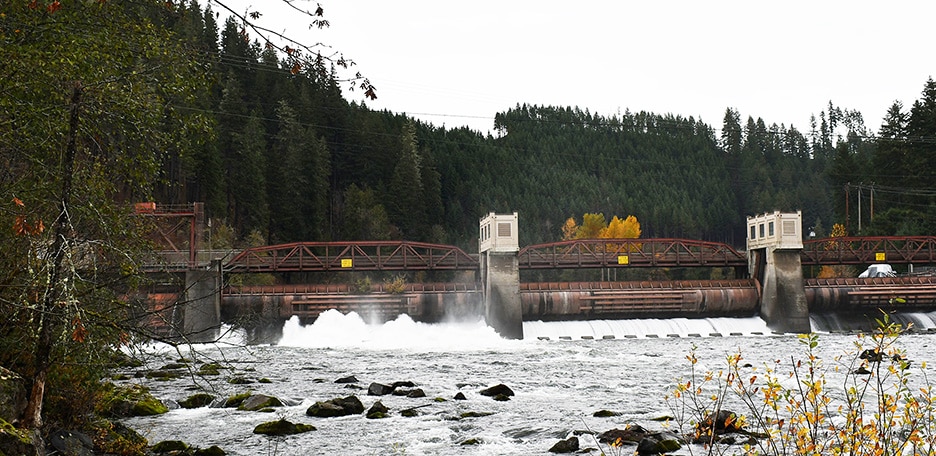
Water released through Rollgate 1, closest to the highway, had been churning while passing through debris jammed into Leaburg Dam.
Nearly 2 million fish at Leaburg Hatchery faced a potentially serious threat that came to an end this Tuesday, when the Eugene Water & Electric Board (EWEB) cleared a debris blockage at the Leaburg Dam. Normal operations were restored, and the hatchery’s water supply was never interrupted.
The work began at 10 a.m., and within 30 minutes the woody debris trapped beneath one of the dam’s three rollgates had been dislodged. Leaburg Reservoir dipped temporarily by 2.2 feet during the flush, yet it stayed above the threshold that would have disrupted water deliveries to the Oregon Department of Fish and Wildlife (ODFW) hatchery.
Officials report the reservoir was back at its normal operating elevation of 742.5 feet above sea level by 12:33 p.m.
During this year’s unusually dry fall, driftwood and other debris had wedged under the dam’s Rollgate No. 1, keeping it from closing completely.
The Leaburg Hatchery, which depends on water diverted from the reservoir to support its fish production operations, was threatened by the blockage. Without rain to maintain the lake level, there was a chance the water supply to the fish hatchery.
Leaburg Hatchery Manager Erik Withalm said the site would lose its water supply if the lake fell to 737.8 feet, while the reservoir’s normal operating elevation is 742.5 feet, a difference of 4.7 feet.
EWEB said a three-foot drawdown threshold would likely impact the hatchery’s water supply. Luckily, the 2.2-foot decline on Tuesday stayed within that limit, so emergency pumping was not needed.
Since October 30, the utility and the Oregon Dept. of Fish & Wildlife had been coordinating for a potential interruption. Emergency pumps were positioned by hatchery personnel, and EWEB worked with the U.S. Army Corps of Engineers to arrange additional water releases from Cougar and Blue River reservoirs.
Releases from the reservoirs helped maintain reservoir levels before the operation and refill the lake afterward.
During the flush, approximately two dozen volunteers monitored exposed shoreline areas, looking for fish and lamprey stranded as water levels declined. Thousands of lamprey that emerged from the mud were relocated by volunteers, according to EWEB. They were moved a short distance back into the submerged portion of the reservoir.
The work was part of a coordinated plan involving EWEB and fish and wildlife agencies to minimize environmental impacts.
McKenzie River flows downstream of Leaburg Dam were expected to increase slightly from the temporary release, though not to flood levels. EWEB also monitored for potential increases in sediment and turbidity.
Fish raised at Leaburg Hatchery are released into regional waterways. They include 112,000 summer steelhead smolts scheduled for release into the McKenzie River in spring 2027: 600,000 spring Chinook juveniles scheduled for release into the McKenzie River in spring 202;. 270,000 rainbow trout, including juvenile and legal-sized fish, designated for stocking throughout the Willamette Valley during the remainder of 2026 and throughout 2027; 1 million spring Chinook sac fry being raised toward a production goal of 600,000 fish for release into the McKenzie River in spring 2028, with potential additional releases into the Coast Fork Willamette River.
Rollgate flushing is a normal maintenance procedure at Leaburg, but this year’s dry conditions made the operation more complicated. A Christmas 2014 emergency came to mind, when Leaburg Hatchery had to run on emergency pumps for 20 days after mechanical failures involving two rollgates.
Luckily on Tuesday, the obstruction was cleared within 30 minutes, and normal reservoir levels were restored shortly afterward.
The hatchery avoided a water outage, but emergency preparations involved equipment rentals, contractor assistance and coordination among several agencies. Withalm said final expenses would depend on equipment rental duration, fuel consumption and contractor labor. “The final bill will depend on how long we had the pumps onsite, how much fuel they used (based on how long they were run), and the final tally of contractor time for setup and demobilization,” he said.
No cost estimate for the operation was provided by EWEB.
To provide safe access for crews and emergency responders, Lloyd Knox Park, Goodpasture Boat Ramp, Leaburg Reservoir, Leaburg Hatchery and the bridge across Leaburg Dam were closed during Tuesday’s operation.
By Wednesday afternoon, Nov. 18, the facilities should reopen, officials said. Normal operations have resumed at Leaburg Dam now that the debris is removed and reservoir levels are restored, ending a potentially serious threat to the hatchery’s water supply.
Anyone reporting an emergency or suspected dam safety issue should contact the Leaburg Duty Operator at 541-852-1906, EWEB advises.