Oregon embraced Carnegie Libraries like no other state
If you walked into almost any city library in the 1880s, chances are you wouldn’t even recognize it.
First off, if you were under 12 years old at the time, you wouldn’t even be let in the door. Children were simply not allowed in.
But if you were of the appropriate age, what you’d walk into would be a room with chairs and a desk and, usually, no windows. Behind the desk would be a librarian. You would have to know exactly what book you wanted, so that you could ask the librarian for it; at that point, a library clerk would scurry back into the “Book Hall” to retrieve it.
The Book Hall was a massive room with walls formed in alcoves, to maximize shelf space. The bookshelves were two stories high, with a little balcony running around the middle to help the clerk access the second story’s books, usually with the help of a dangerous-looking vertical ladder.
The whole vision of a library, in those years of expensive vellum volumes and great social inequality, was as a treasure house of books, which must be protected from an untrustworthy public eager to damage or pilfer. Today’s vision of open stacks with borrowers freely browsing unsupervised through the collection would have horrified an 1860s library architect.
Not that “untrustworthy people” were welcome in an 1860s library.
Libraries back then were not designed with the poor, hard-working immigrant in mind. Libraries sought to serve the sort of folks who, with a straight face, habitually referred to themselves as “the better class of people,” the sort who valued great literature – or, at least, valued being seen with great literature – as a mark of class distinction.
From secret lair to public treasure
But in the twenty years after 1890, this vision of the library was utterly transformed. The average American city library went from a dark, secretive and magnificent place like a necromancer’s hall, to a light, open, egalitarian place in which everyone in town was welcome to come and browse, with comfortable furniture and shelves anyone could reach, and with a special area set aside for children.
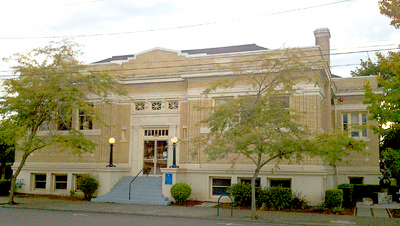
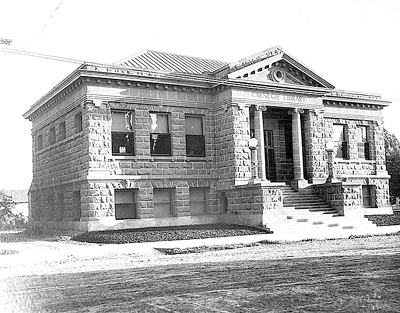
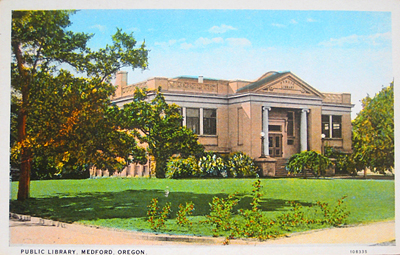
A big part of this transformation was the spending spree Andrew Carnegie embarked on at that same time – an industrialized program of library building in towns and cities around the world. And because it happened just as Oregon was starting to build its cities, it had a really big impact here. No fewer than 32 municipal libraries were built in the state with Carnegie money. On a per-capita basis, Oregon built more
Carnegie libraries than all but a handful of other states – roughly one library for every 2,500 citizens.
And Oregon is the only state in the country in which not a single community that was offered a Carnegie Library failed to raise its matching funds and levy its maintenance- and-staffing tax (10 percent of construction costs, per year) to qualify.
The anti-snob’s vision of a library
Part of the reason Oregon in particular, and the western states in general, responded so well to Carnegie’s library program is its basic egalitarianism. Actually, Carnegie revolutionized philanthropy with this program.
Earlier philanthropists had taken a direct personal and paternal interest in their projects, making large and magnificent monuments to their own eminence in places they had a personal connection with and expecting gratitude in return. Carnegie tried this – Carnegie Hall in Pittsburgh was built that way – but then threw the model aside and replaced it with a more practical system based on the corporation model.
To get a Carnegie library built in your community, you didn’t come to the big man with cap in hand; you submitted an application to his staff – people who didn’t know you and didn’t care who you were, whose job was simply to evaluate your city’s application. It did not, in theory, matter if you were from the most prominent family in town, or had just stepped off a boat from Sicily or Sweden.
The old guard resists
What’s not to like? Well, in a number of more easterly states, this approach caused problems. The upper-class folks who formed local libraries’ boards of trustees tended to prefer the older model, the one in which the library included some built-in barriers to filter out “undesirable types.” A library could be a great place to go be seen cultivating one’s upper-class appreciation for literature, if only those scruffy Polish or Italian or Irish immigrants and their unkempt children could be somehow kept at arm’s length.
Local trustee boards started in right away trying to use Carnegie money to build old-fashioned upper-class monument buildings, which Carnegie saw as snobbery and waste.
In response to this trend, Carnegie’s secretary, James Bertram, became quite strict about library designs. Sumptuous meeting rooms for the trustees, magnificent entryways, and decorative elements meant to overawe the unsophisticated were all one-way tickets to his “no” list.
Wise library boards studied the sample layouts he included with each application packet and built something very similar to one of the diagrams in it. Towns that were committed to the vision of a library as something to reinforce class distinctions either were turned down, or didn’t apply.
Egalitarian Oregon
Sure, that sort of snobbishness was a problem in Oregon too. But the state was young enough that many of its wealthy citizens still remembered what it was like to be fresh off the boat from somewhere with nothing in their pockets.
Carnegie’s goal of crossing class divisions with his libraries sounded just fine to them.
Resistance to Carnegie’s plan wasn’t all because of snobbishness; there were other reasons cities refused his money, too. Carnegie was a ruthless businessman; some of his methods had made him enemies.
In general, the farther away from Pittsburgh a city was, the less likely it was to think of his gift as “tainted money” and refuse it on moral grounds.
Ninety percent of Carnegie’s fortune
By 1919, when Carnegie stopped funding library construction, he’d given away $40 million of his pile. It was a major piece of the total of $350 million that the man gave away in his lifetime – which represented roughly 90 percent of Carnegie’s fortune.
In the process, he’d made educational materials and literature available to millions of people, especially children, in Oregon and other Western states. Through secretary Bertram’s jaded eye, he’d helped transform the popular vision of a public library from the dark, intimidating temple of a hostile god into a bright, wide-open public square, in which any ambitious kid from any family could go and learn what he needed to know to take his “rightful place” in society – and then go forth and change the world, like Carnegie himself had done.
(Sources: Van Slyck, Abigail. Free to All: Carnegie Libraries and American Culture 1890-1920. Chicago: UC Press, 1995; Oregon Library Association Quarterly, spring 1996; Long, James A. Oregon Firsts. North Plains, Ore.: Pumpkin Ridge, 1994)
Finn J.D. John teaches at Oregon State University and writes about odd tidbits of Oregon history. His most recent book, Bad Ideas and Horrible People of Old Oregon, published by Ouragan House last year. To contact him or suggest a topic: finn@offbeatoregon.com or 541-357-2222.
Author