Aurora Colony showcased the ideal of commune life
It has been said of Karl Marx that he was a fine diagnostician, but a lousy prescriber.
Obviously, Marx remains a super polarizing figure even today, a good 175 years after he set the world on fire with The Communist Manifesto. But, in light of what’s been done in his name over the years since then, it’s certainly fair to wonder if ideas like “from each according to his abilities, to each according to his needs” and “the workers should own the means of production” can actually work in the real world.
So it’s ironic that the closest thing to Marx’s ideal vision of society was a little utopian community of devout but antidogmatic Christians in Oregon – none of whose residents had probably ever heard of him.
This is especially ironic because utopian communities have an even worse track record than Marxist states, on a per-capita basis at least. When a utopian commune is founded, it’s usually a matter of a few years before it ends in an undignified mess of litigation and hard feelings and sometimes even bloodshed. The Bride of Christ sect of “holy rollers” under Franz Creffield, in the early nineteen-oughts in Corvallis and Waldport, is probably Exhibit A here. The Heaven’s Gate “UFO cult,” in the 1970s and 1980s, may be Exhibit B. And then there’s “Truth (Pray and Be Cured),” the 1890s starvation cult founded and overseen by Kate Ann Williams, wife of Portland Mayor (and former U.S. Attorney General) George Williams. And who can forget the Bhagwan Shree Rajneesh and his happy band?
But over the years there have been a few communal Utopian societies that even today are consistently cited in positive terms, even by people who are openly hostile to their religious underpinnings.
The Aurora Colony, from the mid-1850s through the late 1870s, was one of them. In fact, I would argue it was the best of them.
Aurora was a colony of a Christian commune called Bethel out of Shelby County, Missouri. It (Aurora) was founded after a big group of Bethel pilgrims emigrated over the Oregon Trail in a wagon train led by a hearse, in 1855.
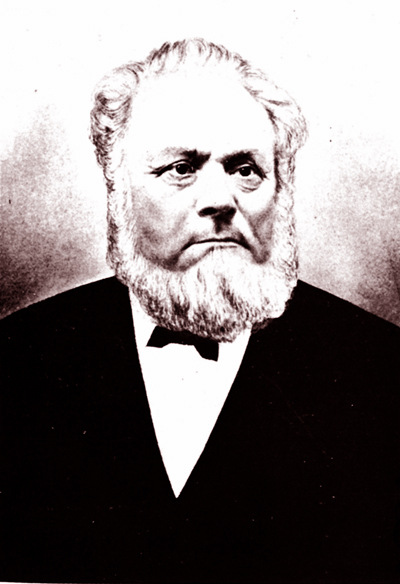
The Bethel pilgrims first came to a spot near Willapa Bay, in the Washington Territory, which its scouts had staked out in advance; but the colony’s leader, Dr. Wilhelm Keil, didn’t like it. The fishing and shellfish-gathering opportunities were top-notch, but it was very isolated and the weather was usually dreary and gray. So the voyagers traveled south, across the Columbia River, to where Dr. Keil’s scouts had found a lovely parcel of land on the Pudding River, with a water-powered sawmill and flour mill already built on it.
Dr. Keil bought it, and named it Aurora after his daughter. For years it was on the maps as Aurora Mills.
The community that now moved onto the land at Aurora and started erecting buildings on it was no gaggle of starry-eyed amateur utopians; they were seasoned communitarians who had already been living this way back in Missouri for more than 10 years.
Aurora soon became the stage for the group’s golden age. Members spoke German in a land that mostly didn’t, which made the social boundaries so important to communal societies easy to maintain. The land was fertile and sunny, and it had mature and productive fruit orchards already in place.
Aurora also was close enough to other settlements that colonists could trade with them. This had been a key to their success in Missouri – they were famous for the high quality of their goods, especially covered wagons, Golden Rule brand whiskey, and the famous Bethel Plow – and they enjoyed a great reputation for square dealing.
Although the Aurora colonists liked to keep a bright line between themselves and outsiders, they were by no means antisocial. The colony, although very serious about its Christianity, exhibited an almost startling lack of crazy dogma, and did not fall into the “outside world is evil” trap. Members were free to talk to outsiders, although not to regularly socialize or marry them (unless, of course, the outsiders wanted to join the group).
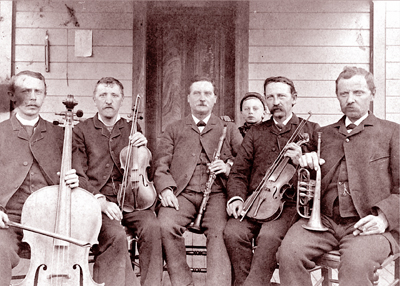
“Dutchtown,” as the colony was informally referred to by outsiders, quickly became famous for its musicians and its hospitality. Travelers journeying up and down the valley from Eugene and Salem to Oregon City and Portland soon started timing their journeys so that evening (or at least lunchtime) would catch them near Aurora Mills, so that they could dine there and stay in its always-immaculate hotel.
The colonists also were instrumental in getting the Oregon State Fair started in 1861, and for years afterward Aurora musicians and goods were proudly featured there.
This was clearly not a cult that wanted to disappear into the wilderness and go its own way, or – to use a more appropriate metaphor for a religious community – to hide its light under a bushel.
So, what was life like in the Aurora Colony? Actually, it was a lot like a starry-eyed Marxist’s vision of what an ideal society would be (except for that whole opium-of-the-masses wheeze, of course). Everyone in the commune worked, but there were no commissars barking orders; everyone sort of followed his or her inclination. Because most of them were German peasants, the default jobs were farming and farmhouse industries like churning butter and spinning wool. Colonists who found themselves to have a particular knack for something else, like blacksmithing or carpentry, would slide smoothly over into that line of work. Nobody worked especially hard, but everybody worked together, so a lot of things got done, and quality was very high.
In the evenings the commune gathered in common areas and visited, played music, drank beer and wine in moderation, and listened to lectures on practical and religious topics. They grew and smoked tobacco, and the quality of the whiskey they made was regionally famous.
Members of the commune could have some private property, but their liquid assets were all held in trust by Dr. Keil, and the necessities of life – food and drink, tobacco, toiletries – were kept in a storehouse that members had full, unlimited access to. The fruits of the community’s labors went directly into this storehouse; members withdrew whatever they needed whenever they needed it. “From each according to his abilities,” as it were, and “to each according to his needs.” (The surplus was either sold or given away to needy neighbors outside the commune.)
They did have a bit of trouble keeping their young men and women in the colony, because the settled communal lifestyle was not very exciting. Over the years a number of prodigal sons and daughters asked to leave the commune. When they did, they were staked with some starting-out money from the commune’s liquid assets and sent on their way with brotherly and sisterly love and the expression of hope that they would one day return. Which, of course, they often did.
Speaking of which, any member of the commune was free to leave the colony at any time.
When he did (or she, but usually it was a he), he would take with him everything he’d originally brought to the commune, including any money contributed to its coffers, plus a stake of traveling money equal to $20 for every year he had been a member over age 18 (for women it was $12 for each year). Members who left were always welcome to return.
The colony’s version of Christianity was relentlessly Biblical, and they resisted all temptation to add any taboos and prohibitions that weren’t clearly stipulated in Scripture. This probably had something to do with Dr. Keil having watched a Christian commune very similar to his own – George Rapp’s Harmony Society, back in Pennsylvania – tear itself to pieces as a result of “Father Rapp” suddenly introducing a new requirement that his members practice celibacy. A number of the Rappites who left Father Rapp’s group in the wake of this extrabiblical decision ended up in Dr. Keil’s colony, and they may have been instrumental in helping Keil avoid a similar fate; but in any case, Keil never deviated from or added to the principles he could find very clearly stated in the Bible.
Keil himself seems to have been that vanishingly rare specimen – an uncorruptible man. His authority over the colony was absolute; he was viewed as a father. He answered only to God. But unlike so many other utopia-chasing leaders over the years who were unable to resist the temptation to exploit their divine mandates to get power and money and sex, Dr. Keil showed no sign of wavering.
He was most definitely a charismatic and unambiguously autocratic leader; but his word was not the highest authority in the commune. God’s word was, represented in the Bible. Any member who objected to an order on Biblical grounds was welcome to appeal it on that basis, and Keil would listen carefully and judge the case humbly and impartially. There was never any con artistry of the “Hey honey, God told me to take you to bed and ‘purify’ you” type as happened with Edmund Creffield, no self-delusion of the “I was talkin’ to God and He said I should starve myself” kind as with “prophetess” Kate Ann Williams. There wasn’t even any “let’s be more Biblical than the Bible by banning stuff that’s fun,” like Father Rapp had done.
It was the most boring, grounded kind of utopia. Which is, in large part, probably why it worked, and kept the colony going for so long. That, and the incorruptibility of Dr. Keil.
But in the mid-1870s, as he got older, members did start to wonder what would happen when Keil was gone. His young son Willie had had some of the old man’s magnetic spark; but Willie was long gone, and none of the other Keil children had the gift.
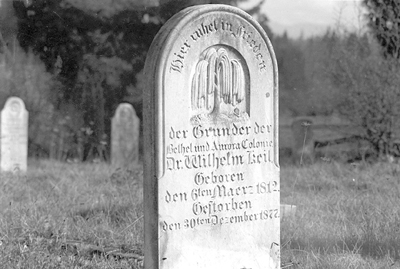
Dr. Keil was concerned about this, too. In 1877, he started having some heart trouble and digestive difficulties, which seemed like a timely reminder. But before he could do anything about it, he died quite suddenly on the day before New Year’s Eve. Apparently his health conditions had been worse than they’d appeared.
Without its benevolent autocrat, the Aurora Colony was simply done. Everyone involved knew this was the end, and that there was no use trying to anoint another leader. Dr. Keil had been a unique character. Finding another like him would be like going through a frog pond kissing everything in sight in hopes one would turn out to be a prince.
So the members of the Aurora Colony simply disbanded the organization. Its communal assets were liquidated with the help of Judge Matthew Deady in federal court, and distributed equally to all the members.
For those members, not much in their lives changed – now they were working their own land and keeping their own storehouses, but they still came together in the evenings for music and lectures and socializing, and they still looked upon their neighbors as brothers and sisters.
The Aurora Colony probably left its biggest imprint on Oregon in the form of cuisine. As the Shaker colonies on the East Coast became famous as woodcrafters, the Aurora Colony earned renown in what we today call, rather bloodlessly, “the hospitality industry.”
Other remnants of the colony are relatively few. Some of the buildings in Aurora today date from the Keil era, and the Old Aurora Colony Historical Museum has preserved many artifacts as well. But there’s something else left there, too – something harder to pin down – and something so subjective that I’m almost embarrassed to mention it. It’s a kind of warm, golden feel that the town has, a sense that this was a special place, a place that served up, for those few decades long ago, some of the best the American Utopian movement had to offer – and shared it unselfishly with the outside world.
Overly romantic hogwash? Probably. But the contrast between Aurora Colony and other cults of its time (and ours) is striking. Keil and his followers certainly were doing some important things right.
(Sources: Aurora, Their Last Utopia, a book by Eugene E. Snyder published in 1993 by Binford & Mort; “The Aurora Colony,” an Oregon State University master’s thesis by Coralie C. Stanton published in 1963; Eden Within Eden, a book by James J. Kopp published in 2009 by OSU Press; Bethel and Aurora, a book by Robert J. Hendricks published in 1933 by Press of the Pioneers; auroracolony.org/history2)
Finn J.D. John teaches at Oregon State University and writes about odd tidbits of Oregon history. His most recent book, Bad Ideas and Horrible People of Old Oregon, published by Ouragan House last year. To contact him or suggest a topic: finn@offbeatoregon.com or 541-357-2222.
Author