After the Burn: McKenzie Region Finds Its Footing
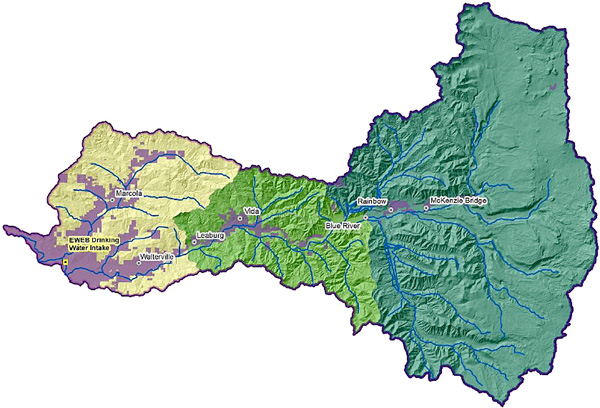
EUGENE: The long recovery from the 2020 Holiday Farm Fire is entering a new phase, according to EWEB’s latest State of the McKenzie Watershed Report. Summed up at the utility’s April 7 board meeting, it notes emergency restoration efforts are largely complete and water quality in the McKenzie River is holding strong despite ongoing challenges.
The report, produced as part of the Eugene Water & Electric Board’s Drinking Water Source Protection program, outlines years of coordinated work to stabilize and restore the McKenzie watershed after one of the most destructive wildfires in Oregon history.
The Holiday Farm Fire burned more than 173,000 acres – over 20% of the watershed – leaving steep slopes vulnerable to erosion and waterways at risk. In response, the Pure Water Partners program worked with more than 300 private landowners to carry out recovery efforts ranging from erosion control to replanting and fuels reduction.
Since 2021, nearly one million native trees and shrubs have been planted on both private and non-federal lands, including 28,000 stems added in the final year of planting. The effort is widely regarded as a model for post-fire restoration on private lands.
Financial assistance has also played a major role. In 2025 alone, more than $1 million in septic system grants was distributed to McKenzie Valley homeowners, although that funding is set to end later this year.
Meanwhile, a temporary watershed recovery fee approved in 2021 has generated $10.3 million, helping leverage an additional $14.6 million in grants for restoration work. Nearly $10 million more has been added to support replanting, floodplain restoration, and strategic land acquisitions.
Other projects include large-scale restoration efforts that are continuing across the region. Work at Quartz Creek was completed in 2025, and planning is underway for a major floodplain restoration project along the South Fork McKenzie River, expected to begin in 2026.
According to the report, 2025 saw relatively low wildfire activity. The lightning-caused Foley Ridge Fire burned nearly 500 acres in September and cost more than $21 million to contain. Smaller fires also ignited during the summer, and smoke from the much larger Emigrant Fire in a neighboring watershed affected local air quality.
The report notes that such events align with earlier predictions that climate change would bring more extreme conditions, including increased wildfire risk, reduced snowpack, and greater stress on river systems.
Monitoring conducted at 15 sites across the watershed showed water quality was stable, and testing for harmful algal blooms found no significant issues during the spring-to-fall season.
Urban runoff along lower sections of the McKenzie continues to be a concern.
The report also detailed ongoing work with partners such as the McKenzie Watershed Council and McKenzie River Trust on floodplain restoration and habitat projects.
Commissioners praised the program’s regional impact, noting that similar watershed recovery efforts elsewhere would benefit from the same level of coordination and funding.
Despite some progress, board members expressed concern about pollution sources in the lower sections of the river, particularly in urban areas.
Discussions highlighted the need for stronger strategies to address stormwater contamination and public behavior, alongside continued monitoring efforts. EWEB staff outlined ongoing partnerships and planned projects aimed at reducing pollution and improving water quality.
The meeting concluded with additional concerns about riverbank erosion near Springfield and potential risks to known contamination sites, with plans to follow up with local and federal agencies.
Author