Regulations Stall Ambulance Plan Despite State Approval
County Code, Provider Boundaries Complicate Rural EMS Fix
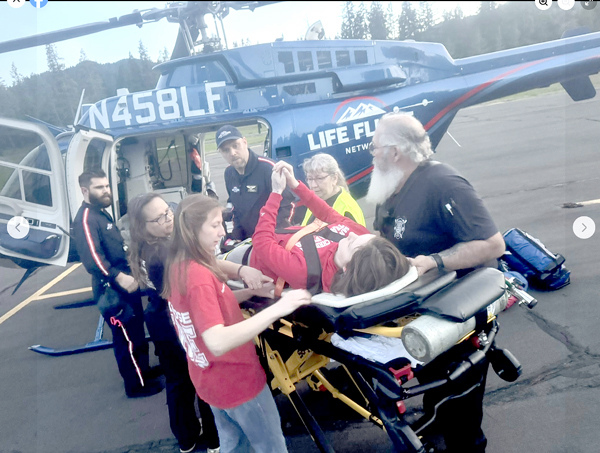
BLUE RIVER: For nearly 20 years, ambulance service boundaries in Lane County have remained largely unchanged, with no new provider requests altering the system. But that stability was disrupted when the Upper McKenzie Rural Fire Protection District began asking a pressing question: “How to improve emergency medical response in a rural community where help can be far away/”
Fire Chief Joel Zeni said the effort is rooted in a long-standing challenge in the Upper McKenzie Valley – distance.
Ambulance transport times in the upper McKenzie area can average close to an hour – from the moment a 911 call is placed. In critical emergencies, those delays can risk becoming life-threatening.
Over the last two years, the district has developed plans aimed at reducing those times without replacing existing ambulance providers. The idea centers on creating a locally based, volunteer-staffed Basic Life Support (BLS) ambulance to move patients closer to advanced care – either by meeting an incoming ambulance or transporting them to a helicopter landing zone.
In 2019 Jacqueline Giustina donated an ambulance, given, Zeni said, “so others may live.”
Turning that concept into reality has required navigating a complex regulatory process and longstanding structural barriers.
Upper McKenzie Rural Fire District attorney Bob Blackmore said the issue is deeply tied to how ambulance services are governed in Oregon. Each county is responsible for managing emergency medical services within its boundaries. Lane County oversees an Ambulance Service Plan (ASP), which is reviewed by the Oregon Health Authority to ensure compliance with state administrative rules.
Within that plan, Ambulance Service Areas (ASAs) each are assigned a provider. In Lane County, Eugene-Springfield Fire (ESF) serves as the primary provider for the length of the McKenzie corridor.
Blackmore said that structure, while effective in urban settings, presents challenges in rural areas where response times are significantly longer.
He pointed to provisions within the county’s code that allow for First Response Vehicles (FRVs), which are designed to improve response times in outlying communities. These vehicles can provide initial medical care, including BLS services, until higher-level care arrives.
“Basic life support can still save many lives,” Blackmore noted, emphasizing that local personnel are trained and capable of delivering critical early care even without advanced life support (ALS) capabilities.
Despite having trained volunteers, proper licensing through the Oregon Health Authority, and a physician supervisor, the Upper McKenzie district has been unable to deploy its ambulance locally due to regulatory constraints and the need for coordination with Eugene Springfield Fire.
One proposal was an Intergovernmental Agreement (IGA) between Upper McKenzie and ESF, which would allow the district to operate its ambulance as a first response vehicle within the existing system. Blackmore said such agreements are common among fire districts and are typically used to address coverage gaps and coordinate services.
However, that agreement has not materialized.
According to Blackmore, ESF has declined to enter into an IGA, citing concerns about liability, training, and oversight – concerns he disputes as unfounded given existing protections, insurance structures, and standard practices across similar agencies.
The lack of agreement has left the district in a difficult position. Blackmore described it as an ethical dilemma: whether to risk regulatory consequences by transporting patients without authorization or wait for outside responders, even when delays could endanger lives.
To better understand potential models, Upper McKenzie officials have looked to other rural systems – including nearby Oakridge.
Oakridge Fire Chief Scott Hollert said his department has operated an ambulance service since the mid-1970s, providing nearly five decades of experience in emergency transport. Unlike the Upper McKenzie proposal, Oakridge ambulances transport patients directly to hospitals, which is the only way agencies can bill for services.
But Hollert cautioned that ambulance service is not a financial solution.
“It’s definitely not a very good moneymaker,” he said, noting the service operates at a deficit each year. In Oakridge, ambulance revenue helps offset broader fire department costs, but does not fully cover them, leaving the city’s general fund to carry part of the burden.
As a city-based department, Oakridge relies on a hybrid funding model combining municipal support with ambulance billing revenue. Upper McKenzie, by contrast, serves an unincorporated rural area, relying heavily on a fire district model and volunteers.
Hollert outlined a staffing approach designed to maintain round-the-clock coverage while controlling costs. Oakridge staffs at least one full-time employee on duty for each 24-hour shift, supported by part-time personnel and a large pool of volunteers. Volunteers receive stipends for on-call shifts, helping ensure at least two responders are available at all times, with additional capacity when more volunteers are present.
The department operates from a single station along Highway 58 and covers a vast Ambulance Service Area – more than 2,200 square miles stretching from milepost 17 to the Klamath County line. In 2018, Oakridge Fire and EMS responded to nearly 1,000 incidents.
The comparison highlights both the possibilities and limitations of rural ambulance systems. What’s working in Oakridge demonstrates that local transport service can be sustained over time, it also underscores the financial and staffing challenges involved.
In the upper McKenzie are, the regulatory path has been complex. The district began seeking licensure through the Oregon Health Authority in July 2025, while also coordinating with Lane County and Eugene Springfield Fire. Initially, officials were told a letter of approval from Lane County was required before the state could conduct an inspection. Despite multiple meetings, that approval wasn’t granted.
A change in state regulations at the start of 2026 removed that requirement, allowing the district to proceed. On February 17, Upper McKenzie completed its inspection, covering facilities, protocols, and personnel. But a complaint related to earlier emergency patient movements briefly delayed the process. On the good news front, on March 31, the district received an ambulance provider license.
Even with that state approval, a key barrier remains.
Under current Lane County code, the district cannot operate its ambulance locally because the area falls within an existing Ambulance Service Area agreement assigned to another provider.
District officials say they have been working since 2024 to resolve the issue and have now submitted a third proposal to amend county code to allow limited operations. At the same time, they are continuing to pursue solutions at interagency levels.
Blackmore said the process has been frustrating, noting that proposed county-level changes could take one to two years to move through advisory committees, despite the urgency of the situation.
Meanwhile, response times remain a critical concern. District officials say delays from outside providers can extend well beyond what is considered the “golden hour” for emergency care – the window in which prompt treatment is most likely to save lives or prevent severe outcomes.
Zeni said the goal is not to overhaul the current system, but to strengthen it in a way that reflects the realities of rural response.
“This is not about changing the entire system,” he said. “It’s about making sure the system works when it matters most.”
As discussions continue, the district is urging community members to stay engaged and participate in public meetings, emphasizing that meaningful change will require coordination with county leaders and Eugene-Springfield Fire.
Area residents can also contact their elected representatives to express their concerns.
Author