Could 60-Mile Main Street Work?
McKenzie Chamber looks to other commnities for lessons on a regional designation
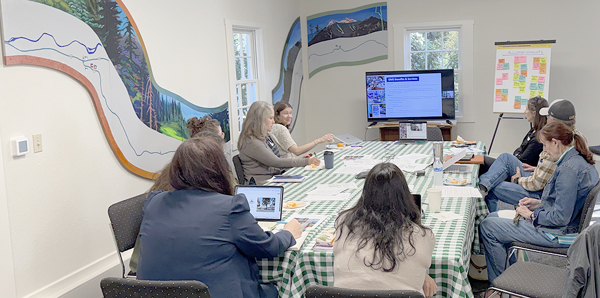
A roughly 60-mile “Main Street” along Highway 126 is the unconventional economic and community development idea the McKenzie River Chamber of Commerce has been exploring. Chamber board members and agency representatives took part in two workshop sessions, held last Friday and Monday, to learn how Oregon’s Main Street model could be adapted to the McKenzie River corridor.
Main Street efforts in Coburg and rural eastern Oregon came under review during the sessions, which supplied examples of how small communities have drawn on the program to organize volunteers, improve properties, attract visitors and investment, and coordinate economic-development plans. Substantially different from the traditional model centered on a few downtown blocks the proposed McKenzie Main Street would link communities, businesses and visitor destinations across approximately 60 miles. The workshops, intended to explore how such a model might work, produced no formal decisions.
Ami Keiffer, Oregon Main Street’s coordinator, discussed how Coburg told how she moved from a traditional chamber of commerce to an organization that uses the Main Street model to coordinate placemaking, community engagement, tourism and economic development. By 2021, Keiffer said, Coburg’s chamber was struggling. Business participation had declined, and much of the organization’s work and financial support fell to a small group of board members and volunteers. Ideas could be generated by the organization, but the capacity to carry them out was lacking.
Community events accounted for much of its activity, prompting participants to jokingly describe themselves as “party planners,” she said.
A different approach came when they looked at the Main Street model, which brought community improvement, business development, tourism and volunteer efforts under a coordinated structure. Particularly relevant she felt, because Coburg is surrounded by protected farmland, opportunities for conventional outward growth were limited.
Important parts of its economic-development strategy became attracting visitors and strengthening existing businesses. A communications hub also emerged, working with the local grange, the Coburg Community Foundation, schools and other community partners.
K’Lynn Lane, formerly with the Frontier Chamber of Commerce and now a community strategist with The Ford Family Foundation, presented an example with particular relevance for a geographically dispersed area such as the McKenzie River corridor. Communities around Condon, Lane described, developed a regional approach to Main Street and economic development instead of limiting their efforts to a single downtown. After decades of population decline, Lane helped develop the “Come Home to Condon” campaign, encouraging former residents and others with ties to the area to return and “bring a job, find a job, create a job.”
Attracting people, however, required more than an invitation. Housing, schools, childcare, reliable internet and community activities were identified through surveys as priorities. Façade improvements, redevelopment of vacant properties, small-business grants and technical assistance were taken up by local organizations. More than 37 members of her 2002 graduating class, along with graduates from nearby schools, eventually returned to the area, Lane said.
As neighboring communities faced many of the same problems of limited staff and volunteer capacity, Lane’s work eventually expanded beyond Condon. Membership grew from 45 members in one community to more than 400 across three counties and 11 frontier communities covering more than 5,100 square miles, she said. Central to the expansion was a paid community ambassador program.
While remaining connected through the larger organization, individual communities established their own Main Street boundaries and priorities. Four Oregon Main Street grants for three communities were secured by the initiative during its first two years, Lane said, bringing more than $500,000 in restoration funding into the region. Through several projects, she said, more than $1.5 million ultimately flowed into the area.
Antelope, population 38, was highlighted by Lane as an example of what even a very small community could accomplish. After joining the regional initiative, the town developed its Dark Sky resources and in 2024 became Oregon’s first International Dark Sky Community.
The Antelope Base Camp received support from a Main Street restoration grant, where an abandoned RV park and closed café were transformed into a dark-sky lodging destination with 10 A-frame cabins and other visitor amenities. Five part-time jobs were created by the development, Lane said.
What the examples presented during the workshops underscored was that a McKenzie River Main Street would not have to resemble a conventional downtown district. The Main Street approach, Lane said, should be adapted by communities to match their own geography, resources and priorities. Along Highway 126, where businesses and communities are dispersed but share a common transportation corridor, visitor economy and regional identity, that flexibility could be particularly important.
Coburg and eastern Oregon, she felt, demonstrated how the Main Street model can extend beyond storefront improvements to provide
Author