County Reverses Course on Floodplain Waiver
Decision raises questions about development rules, disaster assistance
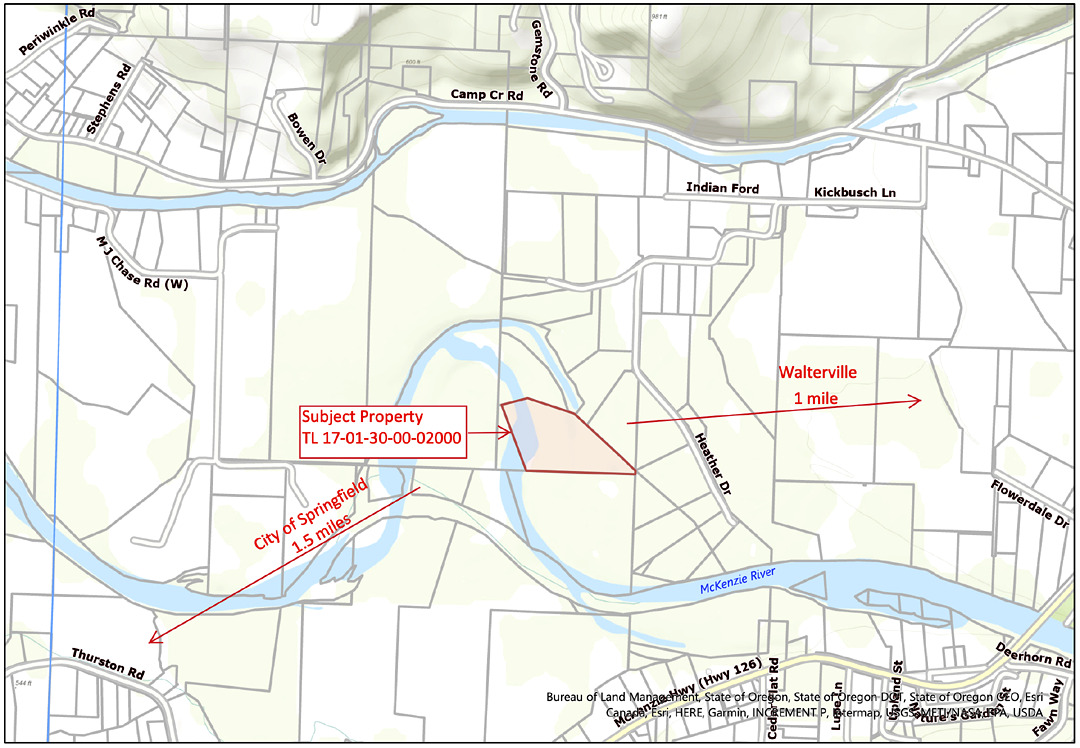
A zoning dispute over unpermitted construction in Walterville has led to a rare political intervention when the Lane County Board of Commissioners voted 3-2 last month to modify their prior decision involving property owned by Kathleen Jones-McCann.
The controversy began on July 7, when commissioners voted 3-1 to overturn county staff and waive provisions of Lane Code, which governs development in flood-prone areas. The exemption was requested by Jones-McCann’s attorney and introduced by North Eugene Commissioner Pat Farr.
The controversy involves two riverfront parcels located off Heather Drive.
Over several years, projects there included three outbuildings totaling more than 5,000 square feet, a solar array, and a concrete retaining wall erected along the riverbank.
Lane County code enforcement and land management staff twice denied retroactive permits for the site, citing violations of zoning laws. However, the Board of Commissioners ultimately exercised their authority to waive the code requirements, legally bringing the structures into compliance and sparing the owner from mandatory demolition orders.
For property owners in rural Lane County, developing near water involves navigating a matrix of environmental boundaries.
Under the county’s riparian regulations, properties sitting within resource-protected zones – such as Impacted Forest (F2) or Exclusive Farm Use (EFU) – are required to maintain a strict 100-foot setback from the ordinary high-water line. For properties designated Rural Residential, a mandatory 50-foot setback applies. Within the boundaries, clearing native vegetation or erecting permanent structures is strictly prohibited without enhancement permits.
Following the July decision, Federal Emergency Management Agency (FEMA) officials contacted county staff about potential conflicts with the National Flood Insurance Program (NFIP).
County Land Management Division Manager Keir Miller warned commissioners that allowing exemptions from floodplain development requirements could threaten Lane County’s standing in the federal program.
The consequences could extend far beyond the property involved in the dispute.
According to Miller, FEMA could place Lane County on probation for a year if the county failed to maintain required floodplain protections. Continued noncompliance could eventually lead to suspension from the insurance program, potentially making flood insurance more expensive or unavailable through the federal program for affected property owners.
Miller also warned that noncompliance could jeopardize certain forms of federal disaster assistance.
At the September meeting, Farr acknowledged that the original waiver had been introduced without adequate review by county planning staff or legal counsel. He proposed modifying the earlier action to address the federal compliance concerns.
The revised motion passed 3-2, with West Lane Commissioner Ryan Cinega, Springfield Commissioner David Loveall, and North Eugene Commissioner Pat Farr in favor.
East Lane Commissioner Heather Buch and South Eugene Commissioner Laurie Trieger were opposed. Both commissioners objected to the underlying decision to overturn county staff’s denial of retroactive permits for the unpermitted structures. Trieger, who had been absent from the earlier meeting on bereavement leave, maintained the county should uphold its established development standards.
By bypassing these rules and securing a political override, critics argue the board has carved out a double standard for wealthy landowners, while everyday residents remain bound by the letter of the law.
The dispute highlights the potential consequences of granting individual exceptions to floodplain regulations that are tied to federal requirements.
Participation in the National Flood Insurance Program depends on local governments adopting and enforcing minimum floodplain management standards. Failure to meet those obligations can affect insurance availability and certain federal assistance programs.
Author