Study Points to Bike/Ped Crossing
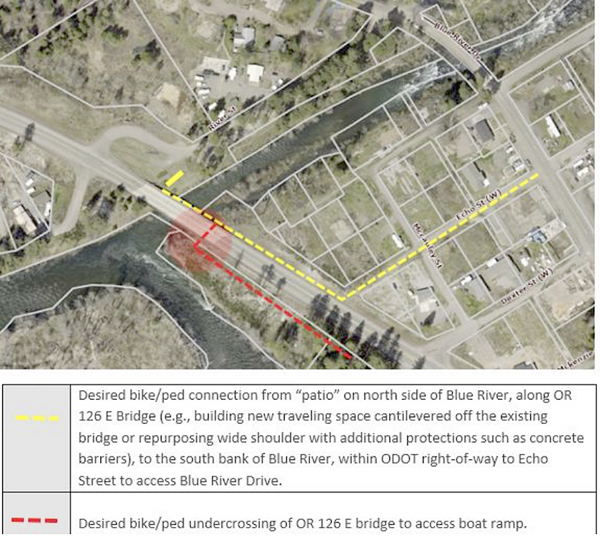
BLUE RIVER: Lane County has wrapped up a study on the historic Blue River Bridge, concluding that the best path forward is to build a separate crossing for pedestrians, cyclists, and emergency vehicles rather than replacing the nearly century-old span.
Built in 1928, the existing bridge is narrow, lacks seismic resilience, and does not meet ADA standards. Despite its shortcomings, residents voiced strong support for preserving the bridge’s cultural and historic character while improving safety and access across the river.
The county’s study, led by engineering firm KPFF, included data collection, site analysis, design concepts, and extensive community engagement. Four crossing alignments and three bridge designs were presented through surveys, virtual and in-person meetings. The community showed clear preference for a new crossing adjacent to the Oregon Department of Transportation’s (ODOT) bridge on Highway 126, citing strong connectivity and minimal neighborhood disruption.
The recommended option – known as Option A – calls for a 215-foot-long, 12-foot-wide structure next to the ODOT bridge. The estimated price tag is about $1 million. More architecturally complex alternatives were also considered, with costs climbing as high as $5.5 million.
The county noted that while previous grant applications for bridge improvements were unsuccessful, the new study provides a stronger case for future funding efforts by confirming community support and identifying viable, cost-effective solutions.
If funded, the project would advance goals outlined in the 2024 Blue River Drive Design Concept, improving bicycle and pedestrian connectivity, boosting transportation resilience, and ensuring emergency access.
Lane County officials say next steps will include pursuing grants, working with ODOT on planning and permitting, and continuing to engage the community as designs move forward.he scope also includes the development of ADA-compliant parking and an accessible pathway.
Author