EWEB and Lane Electric Explore Territory Transfer
Around 3,000 McKenzie area customers could be affected

LEABURG: For more than a century, the Eugene Water & Electric Board (EWEB) has supplied electricity to homes and businesses in the McKenzie Valley. Now, the utility is considering turning that responsibility over to Lane Electric Cooperative – a proposal that has stirred questions, concerns, and cautious optimism among valley residents.
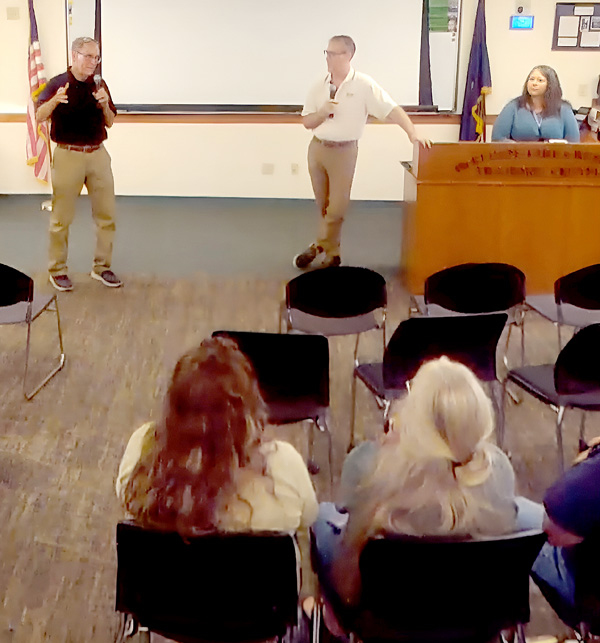
At a recent public meeting hosted by the utilities, some of about 3,000 customers who could be affected by the change heard directly from Frank Lawson, EWEB’s general manager, and Scott Coe, who became Lane Electric’s general manager just three months ago. Both laid out what the shift might mean for the community.
Lawson acknowledged the weight of the decision. “This is about 3% of our customer base, but it’s a very important part of our service territory,” he said, noting that EWEB has served the valley since 1911. He stressed that the process is being handled “with transparency,” with factors -from governance and rates to infrastructure and outage response – were under review.
Lawson stressed that his utility plans to maintain a strong local presence through watershed protection and power generation, even if daily service for area residents shifts to Lane Electric.
Coe, meanwhile, sought to reassure attendees that the coop is prepared to meet the valley’s needs. He described the cooperative’s model of embedding servicemen in rural communities to cut down response times. “Having crews who live and work in the same areas they serve makes a real difference,” Coe said. Lane Electric plans to add a serviceman dedicated to the McKenzie Valley and already has linemen living nearby who could be reassigned.
For some in attendance, that promise of quicker response was appealing. Residents recalled long waits during past outages, when crews had to travel long distances to restore power. Coe also noted that connecting EWEB and Lane Electric’s lines – currently separated by just a few poles near the Vida McKenzie Community Center – would allow electricity to flow from either side during outages, bolstering reliability.
Rates were another hot topic. Lane Electric’s base charge is higher than EWEB’s ($49 versus $30), which raised eyebrows among some customers. But Coe explained that bills vary depending on usage: low-use households would pay slightly more, while higher-use homes might see savings. The difference, he said, typically amounts to no more than $14 per month.
The utilities say they are aiming for a decision soon, with a possible transfer in May. Both the Bonneville Power Administration and Oregon Public Utility Commission would need to sign off first, a process that could take several months.
Questions from the audience went beyond rates and reliability. Residents pressed for details on vegetation management, undergrounding lines in fire-prone areas, and the rollout of smart meters. Coe said Lane Electric expects to finish installing smart meters across its current system by spring and would begin deploying them in the valley soon after any transfer.
Lawson also fielded questions about EWEB’s costly decommissioning of the Leaburg Canal and the uncertain future of the Walterville Canal. He stressed that generation facilities would remain under EWEB’s control and were not part of the proposed handoff.
By the end of the evening, many questions remained, but both managers emphasized cooperation and a shared goal of keeping the lights on. “The utility industry is collaborative by nature,” Lawson said. “When outages and emergencies happen, we all work together.”
For valley residents, the decision is more than a bureaucratic transfer – it’s about who shows up when the power goes out, how much their monthly bills will be, and whether their community remains a priority. As discussions continue this fall, a key local concern seemed to be which path will best serve the McKenzie Valley’s future.
Author