‘We’re Not Done Yet’: Blue River Voices Urge County to Keep 2020 Fire Recovery Momentum Going
Commissioners Promise Action After Hearing Area’s Challenges
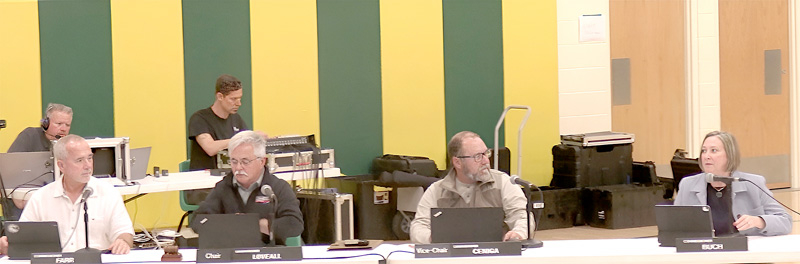
BLUE RIVER: Five years after the Holiday Farm Fire torched through the McKenzie River Valley, Lane County’s governing board came to upriver to hear firsthand how recovery efforts are progressing – and where they’re still falling short.
The Lane County Board of Commissioners held a special session on October 8, at the McKenzie School gym that drew local leaders, residents, and business owners for a wide-ranging discussion on housing, infrastructure, and economic revitalization.
“This community has been through so much,” East Lane Commissioner Heather Buch said in her opening remarks. “We’re here to listen, to learn, and to continue doing what we can to help make the recovery process work better for everyone.”
Public comment quickly revealed a mixture of pride in progress and frustration over lingering barriers.
Lane Tompkins, superintendent of the McKenzie School District, thanked the board for visiting and said that although recovery had come a long way, “there’s still a lot of work ahead.” He added that lessons from the fire’s aftermath are shaping better disaster preparedness for the future.
Brandi Ferguson, representing the McKenzie Community Land Trust (MCLT), shared an encouraging update on six new stick-built homes nearing completion, with families expected to move in by the holidays. She credited the county for helping the nonprofit acquire land, noting that 40% of applicants were fire survivors and more than 80% were members of the local workforce.
But Ferguson also flagged a major concern: “There’s been almost no disaster recovery assistance for commercial properties,” she said, calling the gap a serious obstacle in tools needed to restore a self-sustaining community.
That concern was echoed throughout the meeting. Local business owners Antony Abel and Melanie Stanley both described being stuck in limbo due to insurance disputes and lack of financing options. Stanley said her store rebuild remains stalled because “traditional lenders won’t touch us without a stable income history – and that’s impossible to show when your business burned down.” Reconstruction of her Meyer’s General Store, she noted, is now at a standstill because traditional lenders are wary. Stanley said she feared $2 million earmarked to support business recovery will be allocated via a lottery system that “if obliterated businesses aren’t picked, we don’t stand a chance.”
Mary Ellen Wheeler, program director of the McKenzie Valley Long-Term Recovery Group (MVLTRG), raised another barrier -eligibility rules for the Lazy Days modular housing project. She said young adults who were minors during the 2020 fire but now work locally are being denied housing because they can’t prove a rental history from five years ago. “These are our kids who grew up here, who want to stay and work here,” Wheeler said. “They shouldn’t be excluded.”
Braden Ravenscraft, MCLT‘s homeownership manager, also spoke about the Rose Street neighborhood, the town’s first affordable housing development. He explained how the land trust model allows properties to be held permanently for community benefit, creating affordable homeownership opportunities for generations. The Rose Street homes are expected to sell in the $250,000 to $275,000 range, he said.
Several speakers called for stronger support for small businesses and commercial rebuilding. Jim Parks, chair of the Blue River park and water district boards, proposed offering interest-free loans to help owners reopen. Tabitha Eck, MCLT’s executive director, described how her organization continues leveraging county and state funds to expand workforce housing options. Sha Spady presented an unrelated – but imaginative proposal – developing “dark sky” tourism opportunities as a new economic driver for the valley.
After public comment, Matt McRae, Lane County’s Disaster Recovery Director, introduced several presenters who provided technical updates on recovery programs and infrastructure projects.
Susan Fricke EWEB’s water resources supervisor outlined progress on the septic system funding program, which has distributed $3 million in grants so far. The program has funded 163 septic system repair or replacement projects for properties affected by the Holiday Farm Fire, with grants available through September 1, 2026. Residential systems are eligible for up to $35,000, covering inspections, soil testing, and permit fees. Fricke encouraged more commercial property owners to apply, noting that only two have done so to date.
Lane County Public Works’ special project manager Rob Woodard provided updates on two major Blue River infrastructure projects.
The community wastewater system design is now 95% complete for a 10,000-gallon-per-day treatment facility, capable of serving about 18 homes or a combination of commercial and residential users. The Three Sisters Meadows site has been selected for the facility, but implementation will wait until the community is ready to operate it, Woodard said.
Meanwhile, the Blue River Water Distribution Project is set to begin construction October 20. The project will replace all mains and laterals, creating a looped water system that promises to improves both rates of flow and reliability.
Neil Barrett from Oregon Housing and Community Services (OHCS) discussed state-level recovery programs under ReOregon, which manages federal disaster recovery funds.
The Homeowner Assistance and Reconstruction Program (HARP), Barrett said, has invited 131 individuals to apply, with 33 active cases in progress. The program assists homeowners with rebuilding, purchasing, or replacing homes lost in the fire. Barrett announced key deadlines: residents must complete an eligibility questionnaire by October 31, and all HARP applications are due by December 31.
Betsy Hunter, housing manager for the McKenzie Valley Long Term Recovery Group, presented details on the Accessory Dwelling Unit (ADU) program, which aims to place 20 small homes on private properties to create affordable rentals for workers who earn 80% or less of the area’s median income. The program has identified 36 interested property owners, with 23 likely eligible. However, Hunter noted that state rules requiring two-acre minimum lots limit how many ADUs can actually be built. Commissioners expressed interest in pushing for greater flexibility to allow more workforce housing.
McRae reported that rebuilding continues steadily. Of the 517 dwellings lost in the Holiday Farm Fire, 261 permits (50%) have been issued and 225 homes (44%) have been completed.
He also distribution of $7.9 million in Planning, Infrastructure, and Economic Revitalization (PIER) funds, which include:
$2 million for a Business Recovery Fund expected to launch in November 2025
$1.5 million for fire suppression water tanks
$1.2 million for Blue River Park repairs
$1.1 million for McKenzie School HVAC improvements
$1.2 million for program administration
An additional $5 million state grant has funded projects like the Rose Street neighborhood, ADU pre-site work, rapid rehousing, and infrastructure upgrades.
Author