EWEB Actions on Leaburg, Walterville Projects Carry Direct Implications for McKenzie Valley
Utility Tackles River Safety, Smart Meters, and Leadership Transition
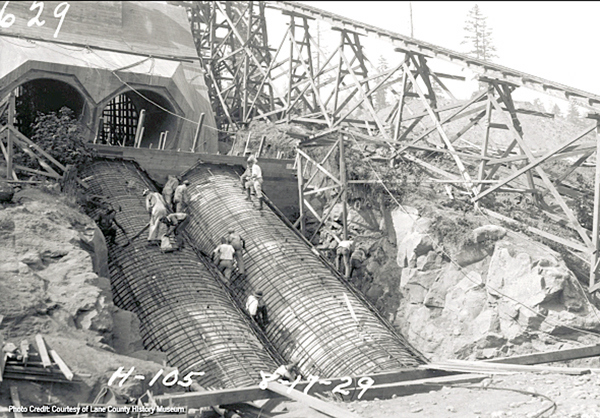
Decisions made by the Eugene Water & Electric Board (EWEB) at its January 6 meeting will have lasting impacts for residents along the McKenzie River, as the utility evaluates safety work, long-term planning, and governance matters tied closely to the Leaburg and Walterville hydroelectric facilities.
Much of the meeting focused on infrastructure along the McKenzie, where EWEB is preparing for eventual decommissioning of aging canals and dams while addressing near-term risks posed by extreme weather and seismic concerns.
Commissioner John Brown raised concerns about customer service response times, citing a 25-minute wait he experienced when calling EWEB. He said delays like that are unacceptable.
Commissioner Mindy Schlossberg offered a contrasting example, praising EWEB staff for a recent home energy assessment that she said provided clear, practical guidance on efficiency improvements.
General Manager Frank Lawson offered details on a “soft launch” of new data tools that analyze data from EWEB’s upgraded meters. The system allows customers to view electricity usage by hour or month, with water usage data also available at longer intervals. Lawson said the data will eventually support “demand-response” programs and give customers greater insight into how and when they use power. They sort of information could be especially valuable for McKenzie Valley households managing higher energy costs, particularly for people relying on electric heating.
Public testimony included comments directly relevant to the McKenzie watershed.
One speaker urged the board to prioritize climate resilience, wildfire preparedness, and affordability when selecting EWEB’s next general manager, noting the increasing risks to water and power systems in fire-prone river corridors like the McKenzie.
Another speaker raised concerns about the proposed watershed bill of rights initiative, arguing that while environmental protections are important, the measure’s broad language could create uncertainty without offering clear enforcement tools.
The board elected new officers for 2026, selecting Commissioner John Brown as board president and Commissioner Carlson as vice president. The vote departed from the traditional succession process after Commissioner Mindy Schlossberg stepped aside.
Chief People Officer Diedre Williams outlined the timeline for hiring a new general manager, with finalist selection expected by early February followed by an employment offer later in the month. Commissioners emphasized the importance of continuity during the transition, particularly as major McKenzie River projects move forward.
EWEB staff provided detailed updates on the Leaburg hydroelectric project, which includes the project’s five-mile canal that runs parallel to the McKenzie River which they said has posed increasing risks during heavy rainfall events.
Staff explained that tributary creeks can overwhelm the canal during extreme weather, raising concerns about erosion, overtopping, and downstream impacts. To reduce those risks, EWEB recently increased water release capacity at Leaburg, completed emergency repairs in late 2025, and began extensive subsurface testing.
A total of 59 test holes are planned to assess structural conditions that EWEB feels are critical to both immediate safety improvements and eventual decommissioning.
EWEB has also acquired additional property near Cogswell Creek to support construction access and risk-reduction work in that area.
At the Walterville facility, progress on designs for a new forebay liner is underway, and are expected to be submitted to the Federal Energy Regulatory Commission later this year. Placement of the liner could occur later this year.
A decision on whether to relicense or decommission the Walterville project could come in 2040.
Of particular interest to McKenzie River residents will be the results of a recently completed a “triple bottom line” transportation analysis done in cooperation with Lane County. The study evaluated the economic, environmental, and social impacts of replacing the river crossing once the Leaburg Dam is removed. Staff said results will be shared with both the EWEB board and Lane County commissioners in the coming months, which will the implications for McKenzie Valley access and emergency routes.
Author