Emergency Spill Response Over at Trail Bridge
No Fish Deaths Observed Following Upper McKenzie Spill
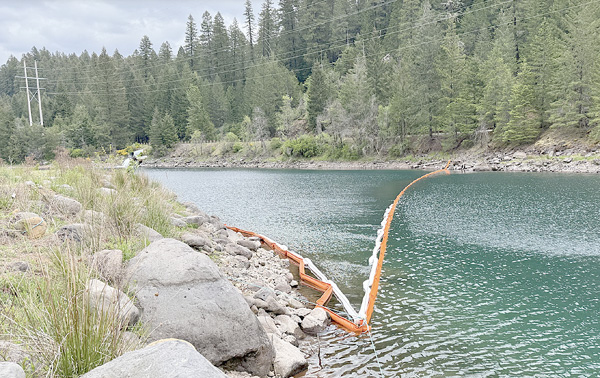
The Eugene Water & Electric Board closed out its emergency spill response following last week’s tanker truck crash near Trailbridge Reservoir that released diesel fuel and thousands of gallons of milk into waterways connected to the Upper McKenzie River.
On Tuesday, May 19, EWEB crews removed containment and absorbent booms from Trail Bridge Reservoir after determining there was no visible oil sheen or evidence of diesel collecting on the barriers. State agencies, however, continued their cleanup work in the immediate spill area.
According to EWEB, the remaining environmental impacts appear to be concentrated around Bobby Creek, where the crash occurred, and nearby Payne Creek, which flows into the McKenzie River just upstream of Trail Bridge Reservoir and EWEB’s Carmen Powerhouse.
EWEB officials said their initial assessment remains unchanged: the spill is not expected to impact drinking water quality.
The utility credited the rapid response by local emergency crews, cold-water conditions in the river system, and the location of the spill for preventing wider contamination.
The response was coordinated through the McKenzie Watershed Emergency Response System (MWERS), a spill response network developed by EWEB decades ago to address hazardous material incidents along the McKenzie River corridor.
The network includes a notification system that alerts responders to spill locations and identifies pre-planned boom deployment sites designed to contain contaminants or protect critical river resources. EWEB also conducts annual training exercises with local agencies.
“This incident reinforces the importance of building relationships, and planning ahead when it comes to responding to emergencies,” said Susan Fricke, EWEB Water Resources and Quality Assurance Supervisor. “The McKenzie Watershed Emergency Response System worked as it was designed to thanks to EWEB and partners’ foresight and dedication to practice – we even ran our spill drill last October in the exact site where we deployed this week.”
Milk, while commonly viewed as harmless, is considered hazardous when released into waterways in large amounts. As bacteria break down the organic material, they consume dissolved oxygen in the water, potentially creating low-oxygen conditions that can suffocate fish and other aquatic life.
The utility’s staff reported they haven’t observed any fish or wildlife deaths during multiple monitoring visits since the spill occurred.
Officials also noted that Trail Bridge Dam itself provides another layer of protection. Floating diesel that might escape upstream cleanup efforts could be trapped by the dam’s permanent containment boom, while the spillway draws water from below the surface, helping prevent surface contaminants from moving downstream.
Cleanup and monitoring efforts are continuing under the direction of the Oregon Department of Environmental Quality and Oregon Department of Transportation, along with hazardous materials contractors.
Many agencies were involved in the response, including the Upper McKenzie Rural Fire Protection District, Springfield Utility Board, Oregon Department of Environmental Quality, Oregon Department of Fish and Wildlife, Oregon Department of Transportation and the Oregon State Police.
Author