Future of Wild Salmon Hits Closeto Home
Bigger challenge include difficult choices for long-term survival
For residents of the McKenzie River Valley, the debate over the future of wild salmon is hardly an abstract one.
The McKenzie is part of a river system where salmon recovery, dams, hydropower, water quality, habitat restoration and the needs of growing communities regularly intersect. Decisions being made today could help determine whether future generations will continue to see wild salmon returning to Northwest rivers.
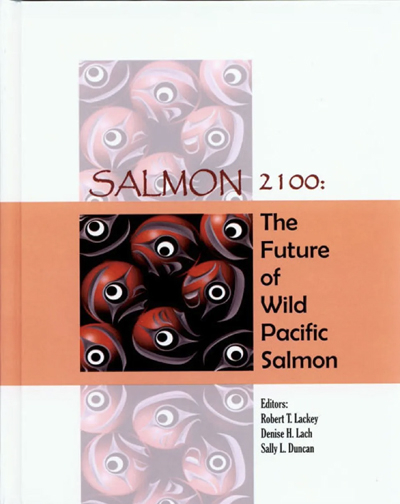
Those difficult choices are at the heart of Salmon 2100: The Future of Wild Pacific Salmon, a 629-page collection examining what it would take to sustain significant wild salmon populations through the end of this century.
Edited by Robert T. Lackey, Denise H. Lach and Sally L. Duncan and published by the American Fisheries Society, the book brings together 36 salmon scientists, resource managers and policy experts. Their geographic focus stretches from California through Oregon and Washington to Idaho and southern British Columbia.
Rather than simply documenting declining salmon populations, the contributors were asked a more difficult question: What would society actually have to do to ensure that substantial populations of wild salmon remain in 2100?
For the McKenzie Valley, many of the issues explored in the book are familiar.
The McKenzie watershed provides habitat for threatened Upper Willamette spring Chinook salmon while also supplying drinking water, recreation and other benefits to communities downstream. The larger Willamette system has also been profoundly altered by dams and other development, making salmon recovery a continuing subject of scientific study, restoration work and public policy.
The book argues that restoring salmon cannot be separated from those competing demands.
Its contributors examine habitat protection, human population growth, land development, energy production, economics, climate, technology and political decision-making. Some explore engineering solutions and advances in fisheries science. Others call for protecting high-priority salmon watersheds or changing economic incentives so conservation becomes more attractive.
Several authors raise an even more fundamental issue: whether society is willing to make the difficult choices necessary to move beyond simply preventing salmon from disappearing.
That distinction – between avoiding extinction and restoring healthy, self-sustaining wild populations – runs throughout the book.
It is a question with particular resonance in the McKenzie watershed, where considerable effort has gone into restoring riparian areas, improving water quality and rebuilding habitat while agencies and communities continue to wrestle with the legacy of dams and other changes to the river system.
The book also includes a Native American perspective on Columbia River salmon restoration and examines the cultural and ethical dimensions of maintaining wild salmon alongside the scientific and economic considerations.
There is no single solution offered in Salmon 2100. In fact, the contributors sometimes disagree sharply about what should be done.
What emerges instead is a warning about the scale of the challenge.
Restoring streams, improving fish passage and repairing habitat remain important, but many contributors conclude those efforts alone may not be enough. Maintaining substantial wild salmon populations through 2100 could require broader decisions about development, energy, water, population growth and how much society is willing to invest – or give up – to preserve salmon.
For communities along the McKenzie, those questions are particularly close to home.
The river flowing past Vida, Blue River and McKenzie Bridge eventually joins the Willamette system, connecting the health of the upper watershed with decisions and conditions far beyond the valley.
Salmon 2100 asks readers to imagine that river nearly three-quarters of a century from now.
Whether wild salmon will still be returning then, the book suggests, will depend less on what people say they value today than on the choices they make between now and 2100.
Salmon 2100: The Future of Wild Pacific Salmon is published by the American Fisheries Society. The hardcover volume is 629 pages and includes color illustrations throughout.
Author