THE SKIWAY ‘TRAM’
City-bus-powered cable car scheme was epic flop
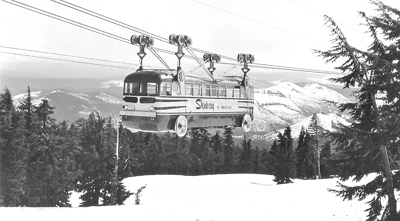
IF THE IDEA of cable car service to Timberline Lodge strikes you as a not particularly bad one, you’re not alone. Over the years since the Wyler group proposed the glass-and-steel mountaintop skyscraper, several proposals have been floated for cable-car service up the mountain.
So far, only one has been built, and it was an immediate and colossal failure: The Skiway Tram project.
The Skiway (originally “Skyway,” but that name turned out to already be trademarked) was the brainchild of Dr. J. Otto George, who came up with the idea just after the Second World War, as the popularity of skiing started to explode nationwide. With a group of other investors, he formed the Mount Hood Aerial Transportation Co. to implement his plan.
The idea would be, rather than properly engineering a six- or eight-passenger gondola in the usual way, to incorporate the latest skyline-logging technology to hoist an entire city bus into the air and haul it up the side of the mountain. Each bus – there were two of them – was modified somewhat crudely to transfer the power from the drive wheels up to a 1.5-inch overhead traction cable, along which it would claw its way up and down the mountain. The whole project would use off-the-shelf parts and equipment modified to work in this new context, so it would be relatively cheap from a research-and-development standpoint.
MOST TRULY BAD ideas are good ideas gone awry through some key detail being overlooked or superadded. Not this one. The Skiway was a bad idea through and through, from the very start. It was slow, loud, and expensive. Enormous amounts of force had to be applied to the traction cable just to move it up the side of the mountain, so the trolleys required two regular bus engines, one at each end, running flat out. The engines weren’t diesels, so they could have been louder; but nonetheless they were plenty noisy, too loud for passengers to carry on a conversation during the trip.
It was also terrifying. A city bus full of passengers weighs 15 to 20 tons, which is a lot of weight to have dangling from a cable in the air. The equipment had been engineered to transport logs that weighed that much and more, so it could easily and safely handle the weight; but loggers running a skyline logging operation don’t worry much about the ride quality for the logs they’re hoisting out. But for the operators of a cable car service, ride quality is everything.
This ride-quality issue would turn out to be the Skiway’s biggest drawback. The weight dragging down the cable would make it sag deeply as the bus moved from one piling to the next, so that the trip up the mountain became a roller-coaster-like cycle of the tram clawing its way up to one of the towers and then almost free-falling down the other side (nose down, of course) before starting the climb to the next. It was not for the faint of heart, nor for the afraid-of-heights.
“I’ve ridden the tramway,” board member George Rauch said, at one of the later company meetings, as the failure of the venture was becoming obvious. “I’ve listened to the shrieks and I’ve taken the jolts over those, what you call them – the saddles, and I’ve heard what people say.”
All these issues might have been OK, but at just about the same time the Skiway opened for passengers, improvements to the highway to Timberline eliminated one of its primary reasons for being. One could now drive to Timberline, or take a ground-based shuttle bus, and get there ten minutes quicker (and, in the case of the bus, for 25 cents less; the tram was 75 cents one-way, and the buses were 50).
WHEN THE SKIWAY flying-bus service opened in 1951, there was considerable nationwide fanfare, and lots of people lined up to ride it. But for most of them, once was enough. Activity quickly dropped off to the point where the sky-buses were idle for months on end. By 1956, the run was shut down, and the Mount Hood Aerial Transportation Co. board was faced with some hard decisions.
Should they pull the buses and replace them with smaller cars? What about investing in a ground-traction system, like ski lifts use, to reduce the weight and noise?
But all these options cost money, and the board had no stomach for risking further sums. A liquidation committee was formed, and by the early 1960s the sky-bus line was no more.
Author