Water Storage Network Expands to Improve Fire Protection
Additions will strengthen firefighting capabilities, with additional installations planned
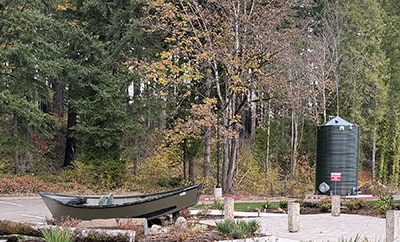
A new water storage tank installed on the grounds of the McKenzie River Discovery Center is helping to increase McKenzie Fire and Rescue’s ability to douse flames in the Leaburg area.
McKenzie Fire & Rescue is addressing one of the toughest problems rural firefighters face – having a dependable water supply readily available when fires break out – by expanding its network of emergency water storage tanks throughout the McKenzie River Valley.
The project, which began following the 2020 Holiday Farm Fire, includes strategically located water tanks ranging from 10,000 to 28,000 gallons.
In areas where hydrants are scarce and rivers, canals or other water sources may be difficult to reach, the tanks give firefighters immediate access to water. The latest additions to the district’s expanding water supply system are two recently completed 15,000-gallon tanks: one along Deerhorn Road near milepost 4, and another at the McKenzie River Discovery Center.
Funding for the installations came through Planning, Infra-structure, and Economic Revital-ization (PIER) funding, including $7.9 million designated for PIER projects in the Holiday Farm Fire recovery area.
The McKenzie Fire & Rescue water storage project was one of six projects selected for funding.
Urban fire departments gener-ally have access to extensive municipal hydrant systems. McKenzie Valley firefighters, however, must frequently rely on rivers, canals, private water tanks and a limited number of hydrants.
In many locations, the nearest accessible water source may be miles from an emergency, and even when the McKenzie River is nearby, steep terrain, limited road access and crowded boat ramps can complicate efforts to draw water.
Additional challenges have come from the prolonged drawdown of the Eugene Water & Electric Board’s Leaburg power canal, which has eliminated or reduced access to several traditional water collection sites.
Staffing is another concern: as volunteer participation declines, the district has fewer personnel available to operate equipment at remote water collection sites.
Because drawing water from a river or boat ramp often requires multiple firefighters for safety, personnel who could otherwise be fighting the fire are diverted.
McKenzie Fire & Rescue reports there are nine existing water storage locations, including the two recently completed. Five more are planned as funding and construction schedules allow, adding another 101,000 gallons of emergency water storage capacity.
Planned locations include EWEB’s Lloyd Knox Park, Goodpasture Road, Mt. Hagen Road Mill Creek Road near Tokatee Golf Course.
Once all five proposed tanks are installed, the district’s storage network would have a combined capacity of approximately 240,000 gallons.
As the water storage project moves forward, McKenzie Fire & Rescue is seeking permission to use a portion of its existing PIER funding to purchase additional firefighting equipment. The proposed change in the project’s scope would allow the district to acquire equipment needed to support fire suppression operations and help fill the new storage tanks.
Lane County commissioners will consider the request during a public meeting on Tuesday, November 17, at 9 a.m., which will include a presentation about the program and an opportunity for residents to provide testimon at the Lane County Public Service Building, 125 E. Eighth Ave., Eugene, with doors opening at 8:45 a.m. The meeting will also be available for viewing through the county’s online webcast.
Author

Related Articles

Oregon’s Merkley, Utah’s Curtis propose extending military death benefits to fallen firefighters
Proposal extending military death benefits to fallen firefighters